Comprendre les ions pour mieux recycler les métaux
24.03.2026, par Sophie Blitman
Mis à jour le 18.03.2026

À Grenoble, un projet de recherche interdisciplinaire étudie, à l’échelle moléculaire, la migration d’ions métalliques entre deux phases liquides. L’objectif : mieux comprendre les mécanismes de séparation de phase et favoriser des procédés de recyclage des métaux moins polluants.
 Diffusion des ions Co2+ de la phase basse vers la phase haute en condition statique © LIPhy
Qu’il s’agisse de téléphones portables ou de matériel informatique, de déchets industriels ou de produits issus de l’extraction minière, recycler les métaux est une activité polluante. Aujourd’hui, les procédés les plus courants reposent sur l’hydrométallurgie : les métaux sont d’abord dissous dans des bains acides (une étape appelée lixiviation), puis extraits à l’aide de solvants organiques souvent polluants. Faire mieux, plus proprement représente un défi majeur pour l’industrie et la recherche.
Directrice de recherche CNRS au Laboratoire d’électrochimie et de physicochimie des matériaux et des interfaces[1], Isabelle Billard explore ce sujet. Chimiste, elle mène ses travaux à l’échelle macroscopique pour « mettre au point, à terme, une sélection efficace d’un ion métallique en milieu aqueux acide, dans une démarche la plus respectueuse possible de l’environnement ».
Mais pour améliorer ces procédés, il est indispensable de comprendre comment le transfert de matière s’opère au niveau microscopique : comment les ions se déplacent-ils ? Comment interagissent-ils avec les molécules du solvant ? Pour répondre à ces questions, Isabelle Billard se tourne vers des collègues physico-chimistes du Laboratoire interdisciplinaire de physique[2] : ainsi naît le projet ITALLIX[3], soutenu par l’Agence nationale de la recherche[4]; depuis 2023 et coordonné par Marie Plazanet, chercheuse CNRS rattachée au LIPhy.
À la croisée de la physique et de la chimie, il s’agit de remplacer les solvants classiques par des liquides ioniques, des sels liquides à température ambiante, réputés pour leur faible volatilité et leur potentiel environnemental plus favorable. Les chercheuses se concentrent sur un phénomène clef : le passage d’un liquide homogène à un système composé de deux phases liquides distinctes. Cette séparation de phase est en effet ce qui permet, in fine, d’isoler les métaux. L’objectif d’ITALLIX est double : comprendre les mécanismes de séparation de phase et étudier la migration des ions métalliques d’une phase à l’autre.
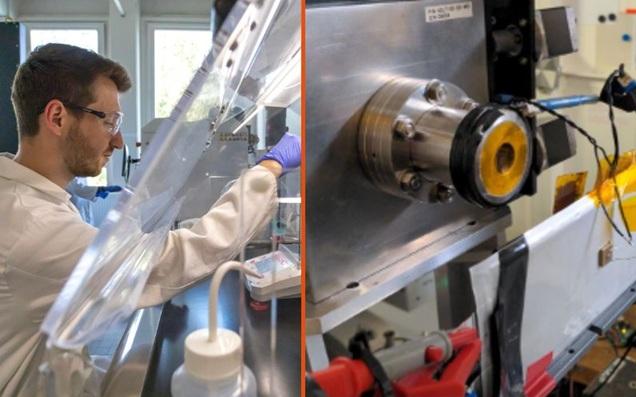
C’est dans ce cadre que Bastien Lebreux réalise sa thèse. Physicien, le jeune chercheur travaille sur un système liquide composé de trois éléments : de l’eau salée, un liquide ionique composé d’un gros cation et d’un ion chlorure et d’un sel métallique.
La séparation de phase sondée par des neutrons
Dans un premier temps, les scientifiques étudient la séparation de phase à température constante, en faisant varier la composition du mélange. Il s’agit de comprendre comment les gros ions du liquide ionique s’organisent à l’échelle moléculaire lorsqu’on ajoute du sel. Pour cela, ils se rendent à l’Institut Laue-Langevin de Grenoble, qui dispose d’un réacteur nucléaire dédié à la recherche et produisant des faisceaux de neutrons. Ces neutrons sont envoyés sur les échantillons de composition variable préparés par Bastien Lebreux : « selon les cas, la proportion d’eau et de liquide ionique change, ou bien elle est fixe mais on ajoute du sel », indique-t-il.
« Observer ce qui se passe à l’échelle moléculaire est essentiel pour comprendre les interactions entre ions et solvants, qui conduisent à la séparation de phase, dans l’objectif d’optimiser ensuite le processus », explique Marie Plazanet. Après des expériences relativement rapides, l’analyse, en revanche, est « assez longue car plusieurs interprétations sont possibles », souligne Bastien Lebreux. Mais les résultats sont très encourageants : ils permettent de déterminer les proportions nécessaires pour obtenir une séparation de phases, comprendre les mécanismes de cette séparation, montrent les similitudes et les différences avec des travaux antérieurs sur des systèmes comparables.
 Schéma de la séparation de phase par ajout de NaCl au mélange eau + liquide ionique © LIPhy
Une étude novatrice de la migration des ions
Dans un deuxième temps, le doctorant s’intéresse à la séparation des métaux dans un système liquide biphasique comportant une interface liquide-liquide eau/eau : un sujet encore très peu exploré. L’enjeu est de comprendre comment la diffusion des ions est influencée par l’écoulement des liquides, leur viscosité ou encore la géométrie du canal dans lequel ils circulent.
Concrètement, le chercheur ajoute du sel jusqu’à obtenir deux phases superposées : une phase dense, majoritairement composée d’eau et de sel, et une phase aqueuse plus légère, riche en liquide ionique. Si ce type de procédé est déjà utilisé industriellement, notamment pour recycler des composants électroniques et séparer différents métaux, l’étude fondamentale du phénomène dans ces nouveaux solvants est, elle, novatrice.
Dans le cadre d’Itallix, les expériences se concentrent sur un seul ion métallique : le cobalt. Dans un système biphasique, certains ions préfèrent naturellement une phase plutôt qu’une autre. L’objectif, ici, est de contrôler leur migration en jouant sur la température ou la composition du mélange. Les scientifiques examinent notamment le rôle de l’interface entre les deux liquides : dans quelle mesure accélère-t-elle ou ralentit-elle le passage des ions ?
Approche statique et en mouvement
Dans une première étude, dite statique, la phase dense contenant le cobalt est surmontée de la phase riche en liquide ionique. Les chercheurs observent la migration des ions sur des durées allant d’un à plusieurs jours, et constatent l’apparition d’une zone appauvrie en ions, au niveau de l’interface.
 Écoulement biphasique le long d'un canal : on observe le transfert des ions de la phase basse vers la phase haute dans le premier tiers environ © LIPhy
La seconde approche est dynamique. Elle repose sur l’utilisation d’une cellule millifluidique : un canal de cinq centimètres de long et d’un demi-centimètre de largeur et profondeur, dans lequel les deux phases s’écoulent côte à côte. L’intérêt de ce dispositif est de renouveler en permanence la quantité de cobalt à l’interface, évitant la formation du « vide » d’ions qui ralentit le processus. Pour étudier la migration des ions métalliques vers la phase supérieure, Bastien Lebreux analyse aussi « le profil de vitesse de l’écoulement, plus rapide au centre que près des parois ». À cela s’ajoute l’effet de la gravité, qui influence la stabilité de l’écoulement.
Les travaux sont toujours en cours, mais les premiers résultats suggèrent que « l’écoulement pourrait accélérer la migration des ions », avance le doctorant, qui souhaite déterminer si l’interface agit comme une barrière énergétique.
Plusieurs paramètres restent encore à explorer : d’autres types d’ions, le débit relatif des deux liquides, le sens de leur écoulement, identique ou à contre-courant, ou encore les différences de viscosité, susceptibles de créer des instabilités à l’interface.
À terme, l’enjeu est clair : optimiser le procédé pour transférer des ions le plus rapidement et le plus efficacement possible vers la phase souhaitée, tout en comprenant finement le couplage entre advection et diffusion, c’est-à-dire comment le transport est influencé à la fois par le mouvement du fluide et le gradient de concentration. Des applications industrielles pourraient voir le jour, mais « les contraintes sont fortes, que ce soit en termes de simplicité d’installation ou de rentabilité », souligne Isabelle Billard. Pour l’instant, la priorité reste donc la compréhension fondamentale des mécanismes en jeu, puis sa modélisation théorique et numérique en partenariat avec l’Institut de Chimie séparative de Marcoule (ICSM). Pour, peut-être un jour, inventer les procédés de recyclage de demain.
[1] Laboratoire d’électrochimie et de physicochimie des matériaux et des interfaces (LEPMI – CNRS / UGA / USMB
[2] Laboratoire interdisciplinaire de physique (LIPhy – CNRS / UGA)
[3] ITALLIX : Transport d'ions à travers une interface liquide-liquide en vue de processus d'extraction métallique
[4] Partenaires du projet :
- Laboratoire interdisciplinaire de Physique (LIPhy – CNRS / UGA)
- Laboratoire d’électrochimie et de physicochimie des matériaux et des interfaces (LEPMI - CNRS / UGA / Grenoble INP - UGA / USMB)
- Institut de chimie séparative de Marcoule (ICSM – CEA / CNRS / UM / ENSCM)
_ _ _
Ces recherches ont été financées en tout ou partie, par l’Agence nationale de la recherche (ANR) au titre du projet ANR - ITALLIX - AAPG22. Cette communication est réalisée et financée dans le cadre de l’appel à projet Sciences Avec et Pour la Société - Culture Scientifique Technique et Industrielle pour les projets JCJC et PRC des appels à projets génériques 2022 (SAPS-CSTI-JCJC et PRC AAPG 22).